
Thinking Small, Editing Long
When Patience Meets Power

From a magical encounter with Maximón in a shadowy Guatemalan temple, through the sweltering streets of Stockton, California, and now into the solitude of editing, I think about how documentary film creation never stops winding through a tangled skein of relationships. Yet, each turn in this kind of small-scale project brings its own wisdom. While field recording demands acute attention to the life, place and action unfolding before the lens, editing calls for a different kind of presence-- the patience to discover story emerging from hundreds of hours of captured moments, the willingness to enter into a deep dialogue with not only the footage -- but with self, with community, and with the larger world that waits beyond the frame.
::::::::
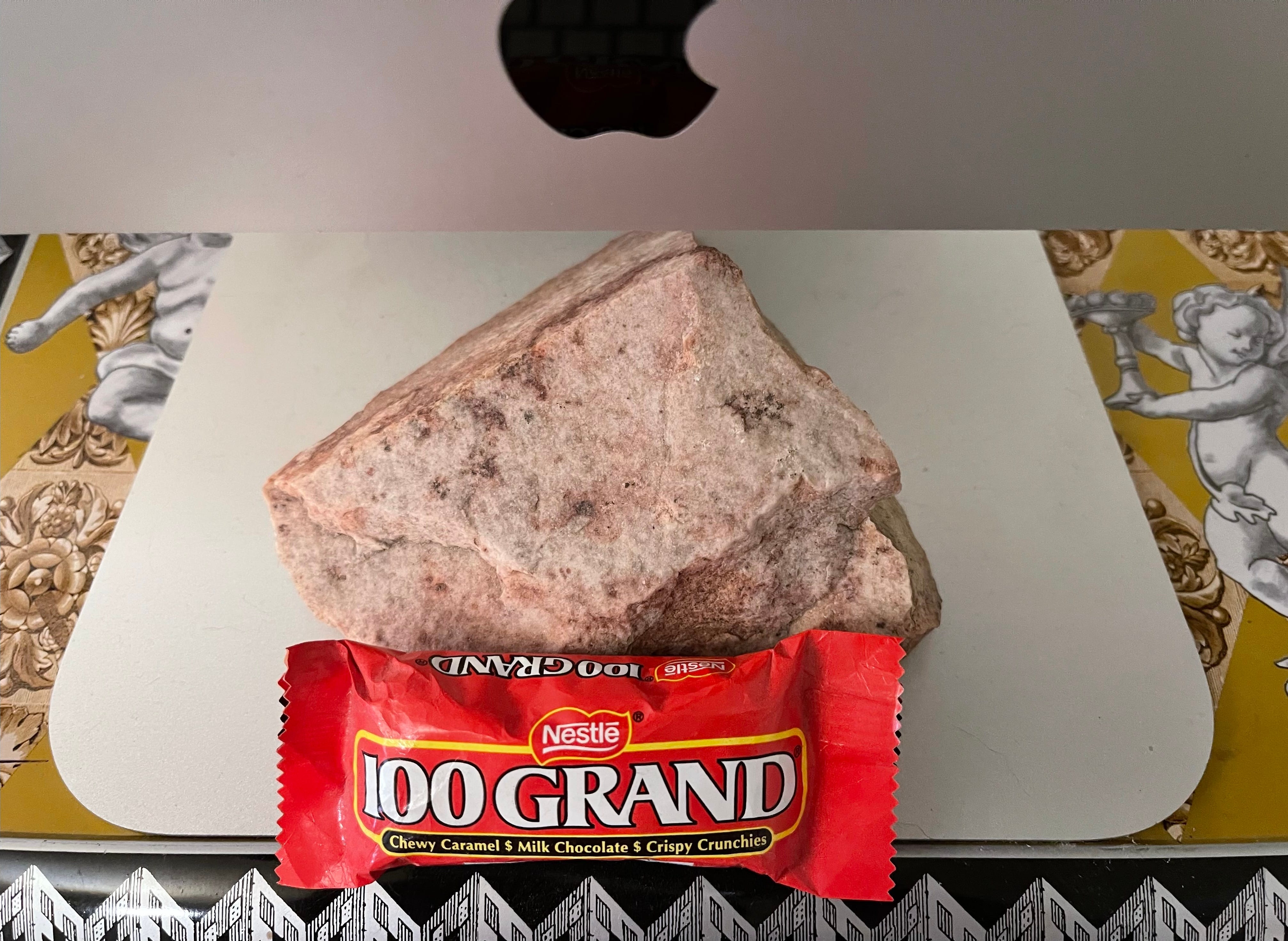
The brushed metal hard drives connect to the IMAC in the attic workroom. Through my southern facing window, sunlight streams past the neighbor's yellow stucco wall. I work up here alone most of the time through the pandemic years. When not looking at the screen, cutting and pasting shots and scenes into digital timelines, I glance down at the chocolate candy bar called A Hundred Grand sitting on the front of the computer. I don’t eat it. It’s a vivid reminder of the budget I still have to raise to continue working with skilled professionals in post-production to bring this project to completion.
This is the reality of independent media making and documentary work -- countless hours sifting through and forming a relationship with the footage, trying to find the elusive story and watching the budget dwindle like melting chocolate. To be sure, there’s no way around it --this particular creative process demands artistic vision, patience, and financial stamina.
The solitude goes beyond budget constraints. It's about creating space necessary to hear and see what the footage and recordings express. Every independent filmmaker knows this sacred, sometimes maddening, dialogue with their material.
In the conventional industrial process, editors will come in after the principal production is completed. They organize the footage, and begin constructing the documentary based on guidance from the film’s director. The director can be very involved in the day-to-day workflow, or the director may only meet with the editor once a week or intermittently. The project flows through multiple hands -- assistants to editors, to sound and music, to colorists and online finishers -- before reaching its public premiere.
Every artist across disciplines knows this routine well. The material is collected. The research is in order. The ideas are now meeting the reality of constructing a piece -- as a story on a screen, an object in space, a set of arguments on the page.
As often as I can work in the editing room I'm humbled by the reality of what is in front of me. Keeping the spark of the original idea and motivation becomes the challenge in the day-to-day world of editing the film. I'm anchored by a view to maintain beginner's mind, be open to any and all possibilities, and listen intently to what the project itself demands.
I may have been a romantic out in the field collecting video material, but now, back inside at my table, I'm a goldminer, a composer, a sculptor, an architect, and an interior designer.
The process becomes what Joe Lambert calls in Seven Stages: Story and the Human Experience "a deep need to re-collect in the form of a story as an artifact. Not just to re-tell but to form and finish a considered text."
This multiple role-switching isn't just about saving money. It's a choice to maintain intimate contact with the story and stylistic decisions at every stage, letting each role inform the others in ways that wouldn't be possible in a more segmented production process. I take this approach because it's what's available for me, and through it, I get energy from a creative freedom that sits next to the constant problem-solving.
I work in film documentary, or "life filming" as I prefer to call it, as an instigator and artisan who participates in every area of the production, from forming the initial proposal and story outline to the distribution. This is a stance that offers benefits and risks. It requires walking a tightrope between the formal conventions of industrial documentary and the snobbism of an art world that does not accept documentary as a legitimate art form. It means choosing to speak to audiences and curious viewers who don’t go to film festivals, awards ceremonies, or even watch tv.
I work alone at this phase to discover the big picture structure and commit to it. I move through and among shots and longer scenes that spark my interest, gathering them in a organized folders, and then sketching out my paper-based Big Map of the story elements. Three interwoven themes emerged organically for this project: Building People Power reveals the grassroots momentum; The Story of Me, The Story of Us captures individual transformation within collective action; and Organizing is Just the Beginning traces the ripple effects beyond the campaign.
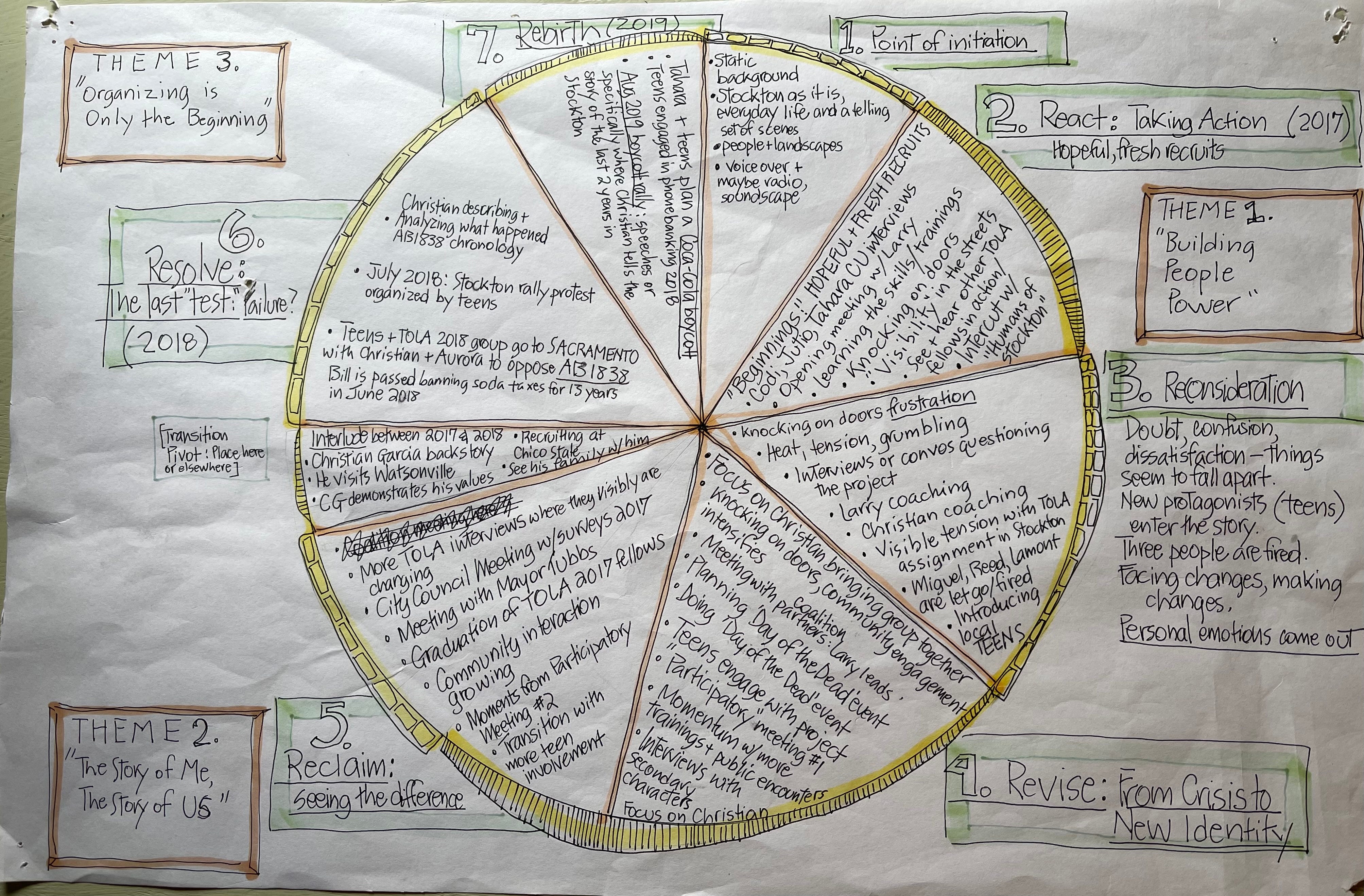
Then, I create different sections based on Lambert's "Seven Stages" approach: the ordinary life in the place as the protagonists enter, when they act and engage, when they fall down into doubt and confusion, when they overcome crisis, tap into their youthful energy to handle final obstacles, and discover each one's deep knowledge and power to take forward.
Out of the few hundred hours of footage, I pick clips that intrigue me -- sometimes for a reason, sometimes just because I find them beautiful or truthful in a way I can't yet define. I often catch myself overthinking, analyzing, second-guessing every clip selection. But when I surrender to intuition, let go of hurry? Magic happens.
After months of ebb and flow of fundraising, I secured the funding to hire short-term editors to work with me and build out different versions of two-minute trailers, ten-minute demo reels, and eventually a rough cut. Three years into this editing process, I find the right collaborator-editor in Brian Woods to bring the project, once and for all, to completion. He connects to the grassroots political story, needs the income, cuts me a discounted payment deal, and becomes my highly skilled, amiable and fearless collaborator at the right time. We sit together working through the sequences as much as we can when we aren’t working at our other jobs.
The story demanded precise balance: motivating a vulnerable city to embrace a soda tax while confronting massive public health challenges, and showing how community organizers work in and around a system that does not have any interest in their goals.
Through 2,000 hours of collaborative editing across fourteen months, we completed the long form film in mid-2024. The timeline might seem long to outsiders, but those who make independent documentaries know that this is how long it takes to do justice to a story that matters -- to find the truth that lives in between the cuts, in the spaces between what was filmed and what emerged in the editing room.
A few fundamental truths about this kind of independent, small documentary excite and inspire me. First, the story emerges through patience and trust in the process. Just as our protagonists in Between the Sun and the Sidewalk had to trust their community organizing work would bear fruit, I had to trust that sitting with the footage day after day would reveal the narrative thread.
Second, working at a small scale isn't just a financial necessity, it's an artistic choice that allows for deeper engagement with the material, and a richer cinematic experience. These constraints become creative advantages.
Finally, documentary editing is a form of social and political organizing itself -- gathering fragments of a 'reality' that the camera records, and composing them with hands and head to build collective power through the witness of ideas, narrative and emotion. This process itself becomes the texture, the invocation, and the container for facing unresolved, evolving questions.
These are lessons that I prove to myself over and over why I choose to work in this way: to create stories that matter, at a human scale, with the care and attention they deserve.
It’s what my late friend and co-writing collaborator Patricia Zimmermann, always called for -- "smaller films, longer conversations."
I love the Big Map photo! I'm going to use that for my memoir. So glad to have just found you through Amber Petty's Pitching Hour.
I didn’t know about Lambert’s book. Thank you so much for sharing your process. I always forget how universal the steps to creating are. Sometimes I get mired in the low points (as I am currently). I needed to read this essay today 🙏🏾.