
Staring at the World

I head across the Richmond Bridge to the Redwood Picnic Area in Mill Valley, California for the Renegade Humanities Collective brunch, a local film community gathering happening before our friend’s documentary premiere at the film festival that Sunday. The morning is bright and warm in October, sun rays shooting down through the trees. The crowd is mostly middle-aged and older, accomplished artists who’ve had the good fortune to stay in the Bay Area putting together a filmmaking life. Our friend’s documentary had taken her more than ten years to make. After the festival circuit, her distribution is uncertain, and making back the costs, even more so.
People are friendly. I ask a friend who makes documentaries about politics and political figures, “how afraid do we need to be?” She says, “not at all.”
The organizers of the event here want Bay Area filmmakers to organize around freedom of expression issues, funding losses, and mobilizing for independent media advocacy. My friend continues, “there’s no reason to retreat now. Especially now.” We both live in a part of California where thousands can show up at the No Kings March and still not think ahead about personal consequences.
There are conversations about news on the closing of public television organizations like CPB. Someone swears there’s an underground network of staffers still sending out checks that were due before Trump cut the various arts agencies. I don’t hear anything new about the Independent TV Service (ITVS) or California Humanities funding, except that ITVS is down to bare bones, and Cal Humanities isn’t funding documentaries anymore.
I leave the event glad that new people are getting involved in the politics of independent media and culture. We’re meeting in-person and piecing together updates. We’re brainstorming creative responses to deeply abnormal actions coming at us from Washington and rippling into our daily lives. “These are special times in the US,” says one of my Chinese college students.
Now reports arrive weekly about film industry layoffs, friends thinking about retraining in health care, downsizing around debt piling up. Yet, the people I talk to are keeping up positive appearances. “How’s it going? Good. I’m still working.” Projects are slowing down. I don’t hear much about how filmmakers are coping with the challenges of doing DIY distribution.
A new acquaintance emails me to ask about teaching jobs at our college where I teach a non-fiction production course one day a week. Highly skilled technical people are planning for the AI takeover of their commercial jobs. A producer tells me that his team just lost access to the hospital where they’d been filming a public health documentary for six months. The organization no longer wanted to take any chances with the media in this current politically charged atmosphere.
Around 2010 funders gave resources to media makers who were re-designing mixtures of documentary and websites as experiments in new forms of storytelling. The idea was that they would be able to grow and deepen new forms of non-fiction on the internet, shaking us free of the ties that previous technologies held us in. Feature length documentaries looked like dinosaurs. They seemed so over-produced, expensive, increasingly fancy, and not fitted for the high velocity digital era.
Yet, those of us who uncovered new pockets of experimentation found that our internet-based hybrid efforts, open to all, couldn’t be monetized. They weren’t going to be presented on television or in film festivals. Writers didn’t understand them enough to champion them in non-academic publications.
Many of these new media projects were made in the public interest, free to anyone who wanted to spend time learning with them and enjoying their nonlinear ways of presenting story. By the early 2020s funders were dropping new media and returning to supporting classically formed documentaries, the bigger, more stimulating and entertaining, the better. And so, the dinosaurs lumbered on. New media projects retreated into academia and art world byways, or were abandoned to slowly decompose online as newer platforms left them behind.
At the Renegade brunch, we talk about the crisis. We talk about organizing. We don’t talk about what to make now or how to make it differently. We don’t talk about staring at the world.
Back at my desk, I take some notes about what I’m hearing. I call this little attic with a window my workroom. Not a studio or an office. I climb up the wooden ladder to reach it. There’s the fuzzy minty yellow carpet on the floor that I must vacuum weekly for dust and cat hair. My simple functional desk, handmade thirty-five years ago by a local girl carpenter in Minneapolis, sits snugly across the one wall with a window, fits into the corner and then ranges across the wall without a window. I can swivel my chair easily between the two views.
The books on the Scandinavian style bookshelves have lived in this room since we moved here in 1998. Before that, they’d travel with me from San Francisco to New York to San Diego, and back to San Francisco, over to Minneapolis, and then, for more than three decades later, settled in this workroom in Albany, California.
Most of the time, the room is tidy and uncluttered. My paper materials and files live on shelves behind a Japanese screen I purchased during the pandemic so the background to my non-stop Zoom meetings would not reveal shelves of nondescript administrative files, papers and stationery. They’re tidy, but too busy for a Zoom background. And who’d want to be distracted by a white foam core board in the background with day-glow post-it notes arranged in a hypothetical structure for the film, now finished, that I’d been editing for more than two years?
In all these years, over several laptops, and children grown up, I’ve sat in this room writing, emailing, zooming, reading, meditating, editing video, listening to music, staring out the window. And now, “scrolling.”
A roll of pristine butcher paper sits in a corner. When I can carve out an hour, I’ll unroll a few feet, sit on the floor, make marks, write down ideas that pop up. I’m not planning here, nor making lists to get done. Just using my hands with pencils, markers and pens.
Today, as I write this, there is more clutter around the surfaces than I’d like – those piles of paper files needing to be sorted and thrown out. One moment they’re stacked and dusty on top of a bookshelf in the corner, and a minute later I’ve scattered them across the carpet. Why have I kept all this?
I ignore the why for now. The past has limited real estate in the workroom, and the files must go in the recycling.
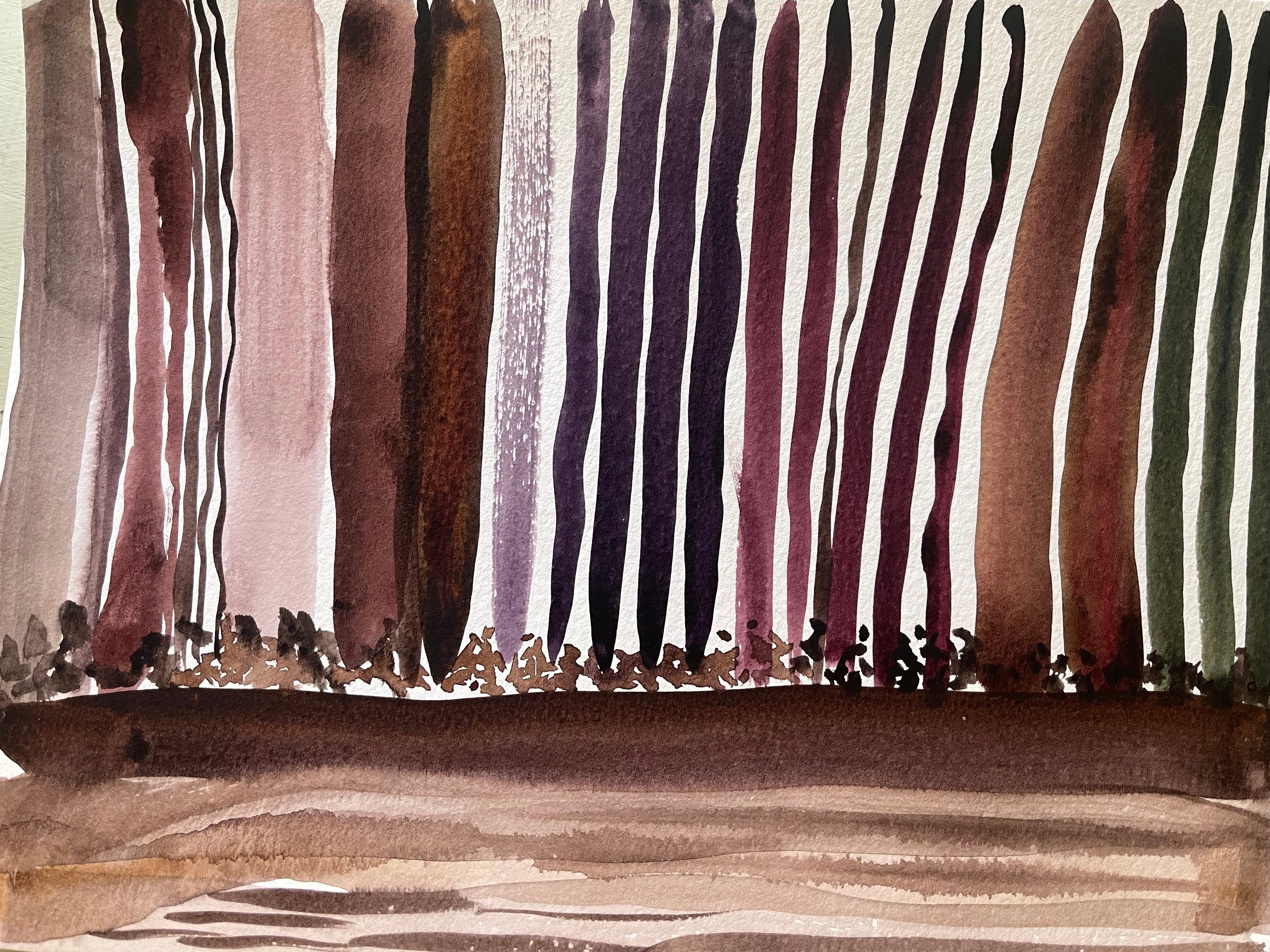
On the carpet today, though, is a box with watercolor paints and brushes, pencils and inks that I also bought during the pandemic. Over the past five years I’ve also kept these items in the corner by the ladder. During the pandemic I’d started some painting and drawing on sketch pads, but so little. The desire to use my hands with colors on paper was stronger than the discipline to simply start with attitude and purpose. They sat there for years. This month I started using them.
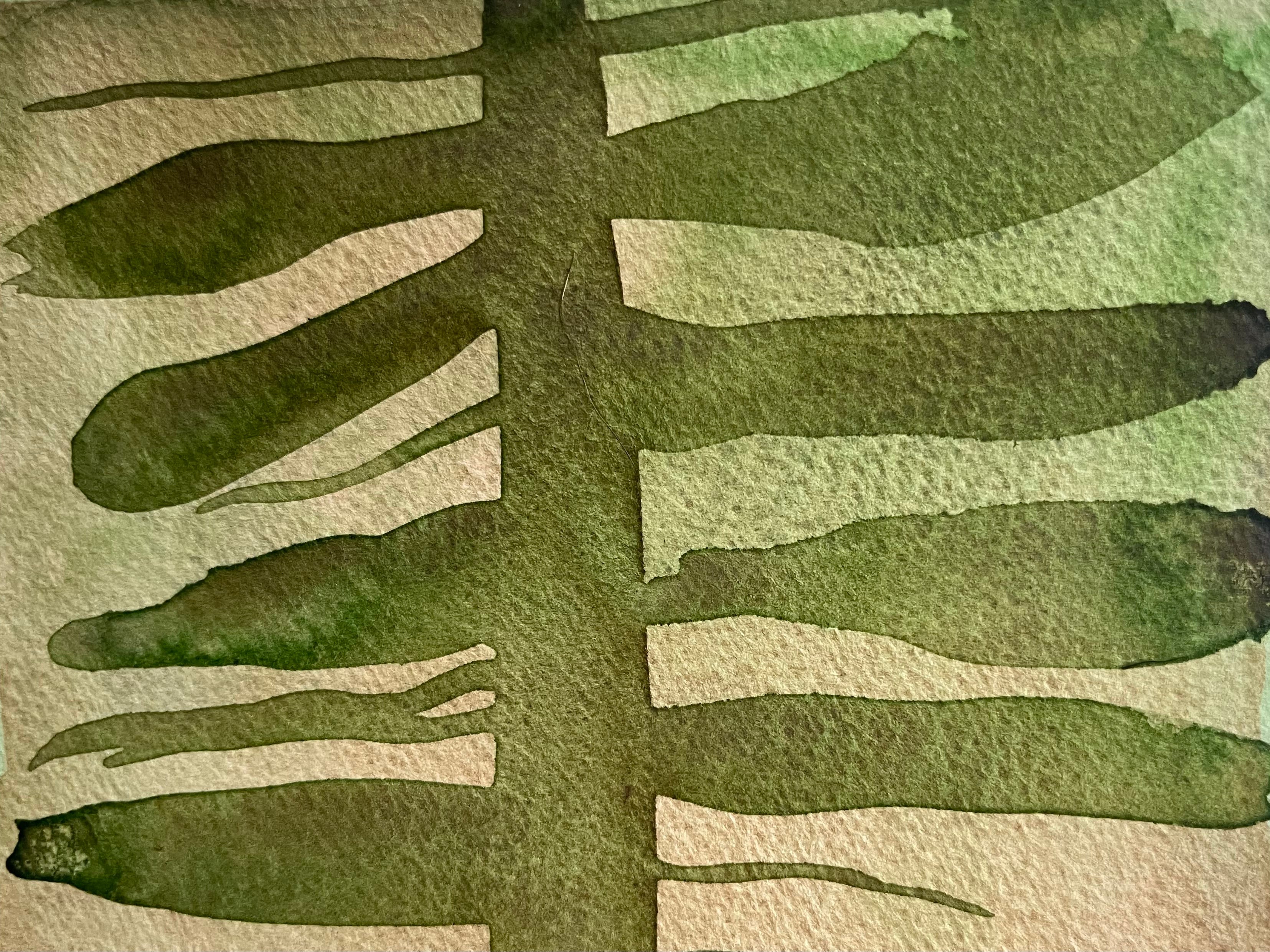
Thursday evening, in the San Francisco City College Chinatown classroom, 14th floor -- I’m taking an Introduction to Watercolor workshop taught by a painter I know. With instructions we’ve had of the various basic techniques, I take out my brushes, fill the water cup, open my palette, and stare at the block of paper on my table.
Our instructor, Erik, says while demonstrating a flat wet wash, “be like water.”
We talk about composition and building the picture from light washes to darkly saturated strokes, layering with a light hand. He also asks us to consider the negative space where color does not live on the paper.
By 8pm, I’m staring out at the city skyscraper lights. I see my brushstrokes are neither confident nor controlled. Yet the heavy, smooth feel of the wide flat brush pulling tinted water across the grids I penciled in on the Arches paper is so seductive. I mix all kinds of color combinations. This is a place where things get started.
Making my brush strokes simply and wobbly, being like water, squirting out tiny blobs from the Winsor Newton tubes, a thought occurs.
Independent documentary filmmaking follows a sequence: write proposals, raise money, shoot, edit, export, submit, distribute, measure impact, report to funders. Repeat. This is the cost of working in this environment.
Watercolor is intimate, close, technical. Mixing paint, wetting paper, touching brush to surface, watching what happens and waiting. And the scroll? Simply unfurling the roll of paper, making marks, writing phrases. No pitch decks, no deliverables, no funder reports.
I started making this way as a kid, before moving image, before documentary. The question: how was I formed as a media maker? Where did the looking start, before I had a camera to look through? I’m excavating.
The political organizing continues slowly, and then quickly. This weekend, the Renegade Humanities Collective called another gathering at an Oakland bookstore. Once again, filmmakers show up to socialize, pick up news, and swap stories on projects. We talk about advocacy, mobilizing, and finding ways to work together. Asking for help, I reach out to a few friends about my film’s distribution. I hand out the film’s postcard announcement to the librarians, explaining the unusual timeliness of the story we produced.
And still, on Thursday nights, I have watercolor class in Chinatown. Most mornings, I write for thirty minutes, sometimes a lot more. When there’s time, I unroll the scroll on the floor in my workroom. I make marks on next section of white paper. Here I’m excavating -- going back to before computer screens, before cameras, back to a time where the looking started and my hands moved freely on paper.
At these gatherings, there’s talk about letter writing campaigns, collaborating with the librarians, presenting our films in little local museums. We don’t talk about what to make or how to make it differently. I know awareness and activism is more than necessary right now. It is urgent.
But I also need this --being like water. Small drops that flood parched earth. The scroll, the brush, the drawings and scribbles on paper. Making marks quietly, while organizing happens urgently.
This documentary crisis continues. The meetings continue. Screenings and events continue. My excavation continues. I don’t know what can emerge from going back to origins and from staring at the world.
So, the work simply continues.
*******
My latest film, BETWEEN THE SUN AND THE SIDEWALK follows young health equity organizers in California’s Central Valley - staring at their world, organizing their communities, making change happen despite impossible odds. The film took eight years to make and is now available for community screenings everywhere! If you want more information about our screening events, I’d love to hear from you: helen@thirtyleaves.org