
Beyond Applause
Finding success in the spaces between

Documentary practice, in an open space new media way, isn’t just about capturing and projecting one’s view of reality. It’s about creating containers where new ways of thinking, listening, relating and co-creating are welcome to emerge across differences.
:::::::::::::::::::::::::::
I wear my street shoes into the early 20th century ballroom at The Berkeley City Club. I’m starting Argentinian tango lessons with eighteen strangers. This had been a vague desire of mine that I carried for seven years since a visit to Buenos Aires. On a cold and rainy February evening, I simply decided to go and do it without much thought. Exercise, movement, dance – they’ve helped keep away the fears and isolation churning up in through these dark, disturbing early months of 2025.
The dancers don’t talk much as they lace up their dance practice shoes. Our professional instructors, so graceful and light, work on new figures to teach tonight. We begin warming up with the gliding tango walk. I take on the part of follower, holding up half the dance structure. I try to relax, breathe and loosen my grip on the leader’s shoulder. The intricate rhythm and melody of the music - bandoleon, violin and bass without percussion – pulls us along wave-like around the vintage dance floor.
Tango demands an enormous effort on my part to learn the basic movement grammar from feet to hips, from chest to head. For those few breaths when I stop controlling the steps, I feel poised, confident and calm. Paradoxically, the strict form offers escape from the usual thoughts of humiliation, stranger fear, distraction and self-judgment when jumping into a new creative activity.
I stumble and hesitate through practice couplings. Slowly, I sense the structure forming between myself and the leader. Our instructor tells me “don’t squeeze his hand so hard. The leader expects a firm yet light touch.” For the dance to take off, we communicate through a subtle push and pull, a motion of resistance and surrender. When I let the leader signal through their steps when to attempt a swirly “ocho” with my leg, it happens effortlessly, without thinking.
I laugh at how I make missteps. Yet, this continual, focused awareness of the formal structure intrigues me. It awakens a surprising and subtle connection across hands, arms and shoulders with a partner who shows patience with my beginner errors. When I regain my posture and stance, my confidence returns. Maybe I’ll get a real pair of practice shoes, and dare to show up at one of the many local Milonga community dances.
Even as a novice, I’m learning to love this beautiful container where we can express form as an entangled body conversation between two people, and then extending it outward to a silent group conversation among and around all the dancers in the room.
The instructor mentions that tango embodies connection, communication and collaboration. In that moment I realize why this new challenge feels so familiar.
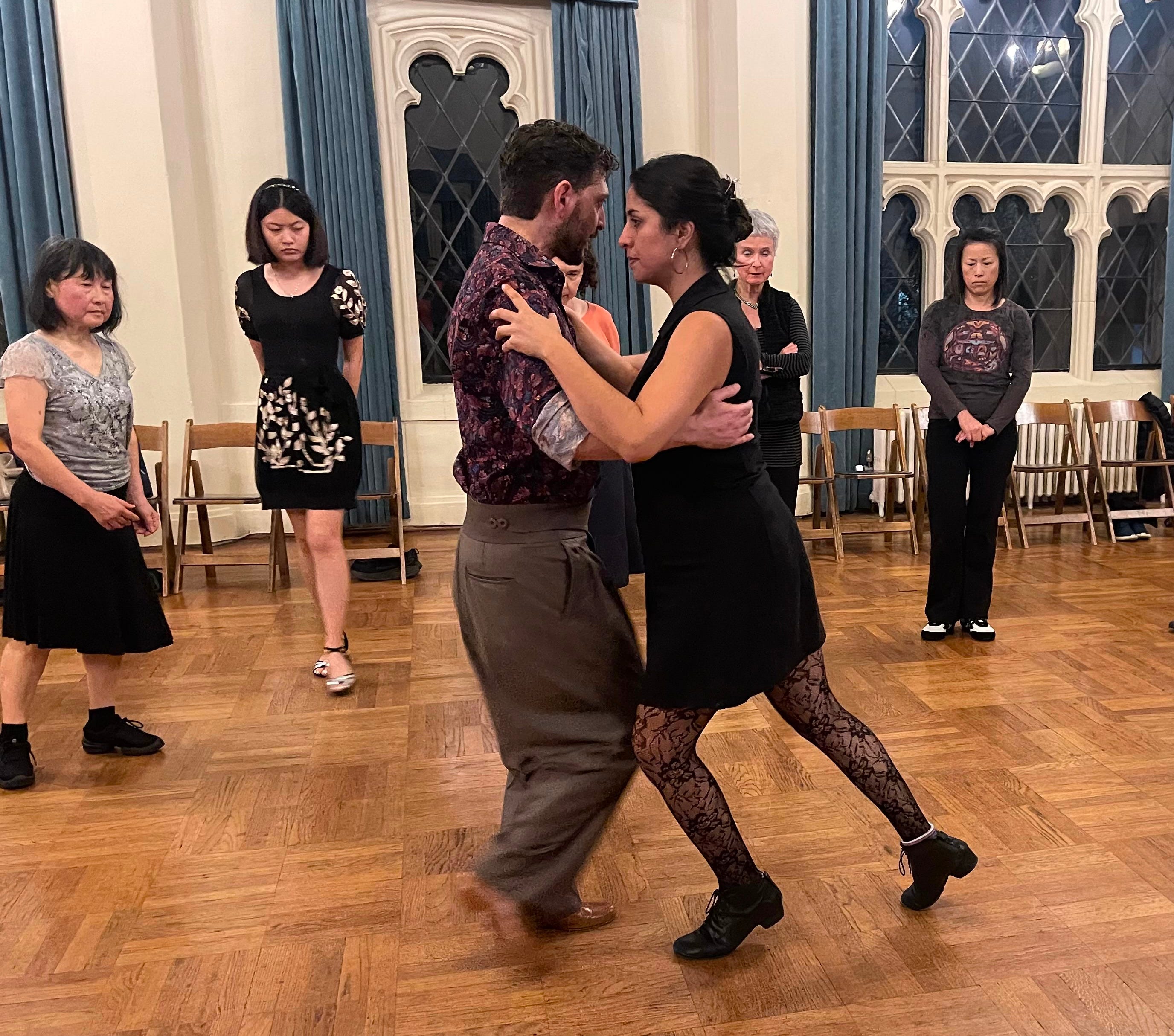
Just like working in documentary production, tango has its own rules and frames that enable freedom to improvise in the liminal space between partners. Documentary filmmaking, like tango, shapes a vessel for emotional involvement and empathic learning that resonates far beyond the screen.
This particular storytelling medium also captures the visceral power of connection, communication and collaboration. Whether in the frustration after a difficult lesson, or in the afterglow of a session where my body finally clicks into motion, I find myself looking at how I measure success – be it in filmmaking, dance, or any other creative discipline I’m working with.
Would success and achievement be defined by a kind of technical perfection – hitting every step, winning critical attention and gathering festival awards – or by qualities more elusive, mysterious and soulmaking for the artist and the audience?
This question haunted me for years. I remembered a night in New York when a group of us, friends from our MFA graduate program at UC San Diego, had gathered for a middle-aged reunion. After dinner and drinks, our friend, a painter, whose work hung in small spaces and not in the large prestigious galleries he’d wished for, threw out a rhetorical question. He poured another drink, looked around and asked, “Why is it, that none of us here reached the success we’d wanted from the art world or the film world?”
The question stung. It exposed a shared, unexamined assumption of the early 21st century creative life: like it or not, we measured success by external attention and validation. It meant financial and other hidden status rewards bestowed by gatekeepers who controlled access through their own tastes and prestigious platforms.
For years, the rebel in me wanted to talk back to our friend at the bar. In a replay of that scene, I'd argue with him, and clearly point out what I believed were other, unusual ways to define success that weren’t about playing the game correctly, and that didn't ring hollow and conventional. I realized that I could shape ideas and practices that made more sense to me so I could face and work in this new world of blended, mutating and evolving media forms.
There was no question that we had to meet and work with the enormous changes in the digital networked era. New tools completely changed how we made media and what we expected from it. As independent filmmakers, we could reach viewers rapidly in ways never dreamed of before. We could experiment with interactivity and engagement, and meet our audiences directly.
When I encountered the work of two thinkers who wrote about how to talk together and work together in real world settings that might be complicated, confusing and challenging, I heard some truths I wanted to integrate into my film work. How could I combine process facilitator and theorist Adam Kahane's insights about stretch collaboration, and physicist David Bohm's concept of dialogue and participatory consciousness into the kinds of films I wanted to make and put out into the world?
Their ideas resonated with my experiences. They were offering a form in which to expand beyond the screen's frame, and co-create a container for thinking aloud in dialogue and community.
In his book, Collaborating with the Enemy, Kahane presents stretch collaboration as working across domains and silos where deep differences among collaborators can exist. It's a kind of messiness that grows in ensembles, networks, or communities. And it’s something that filmmakers don’t like talking about in public.
Stretch collaboration happens when we want or need to reach out beyond comfortable hierarchies and outcomes. In his experiences working around the world as a facilitator in extremely challenging situations, Kahane asks collaborators to embrace connection, conflict and multiple co-creators at different stages of the process. It’s tough, unrelenting and always uncertain. But the stretch is courageous and often lead to breakthroughs.
When I first considered this push and pull approach in the context of film production and distribution, it did not seem functional. Why would I, as a filmmaker holding the power of a vision, want to allow discordant ideas and voices to mess up the final outcome?
Nevertheless, it put words to what I’d been intuitively moving toward. The messiness Kahane describes felt familiar—those moments when a film team, our subjects, and eventually the audiences co-create something together that none of us could have planned. Recognizing this as a feature rather than a flaw shifted how I viewed 'successful' production days. Sometimes the most valuable moments would come when plans fell apart, forcing us to stretch beyond the illusion of professional, masterful roles.
It's when I stopped looking ahead towards the final product that I connected David Bohm’s thinking in his slender book, On Dialogue with Kahane’s structures of stretch collaboration.
Bohm’s concept of the dialogue process offered a theoretical foundation for what I'd observed informally during screening and speaking tours across the country. His idea of suspending judgment in order to generate a shared collective meaning explained why some post-film discussions transcended the usual Q&A format while others remained superficial.
I saw that my role wasn't only to make films, but more importantly, to design mediated experiences where this suspension of fixed positions would occur—where the film was just the beginning of a collective thinking process that could continue on in people’s imaginations and communities.
The question for me then became: how does documentary, as both a creative practice and public service, actively explore shared meaning and spark collaborative inquiry? How does it live on beyond a consumable story among millions of others? How do we encourage ourselves and other people to care and act individually and alongside others with whom we might agree or disagree?
Bohm and Kahane’s models continue to transform how I measure success and achievement. Rather than chasing Sundance dreams or Netflix deals, I've come to value the post-screening events and dialogues where strangers connect across political divides to create new and durable structures they didn’t even know could exist. When a film takes years to complete, this approach feels especially urgent in our current moment of manufactured polarization, fractured public discourse and unceasing noise.
When I stare at my feet during tango lessons, clutching my partner's shoulder, and trying to control every movement, the dance falls apart. When I obsess over how audiences should interpret my films or react to screenings, something essential is lost.
I’d now respond to my friend that success doesn’t come from perfect execution or universal acclaim, rather it emerges and grows in spaces where authentic connection, fragile as it may be, can flourish. The most meaningful moments—whether on the dance floor or after a screening—happen when I loosen my grip on control and trust the container itself to hold what unfolds.
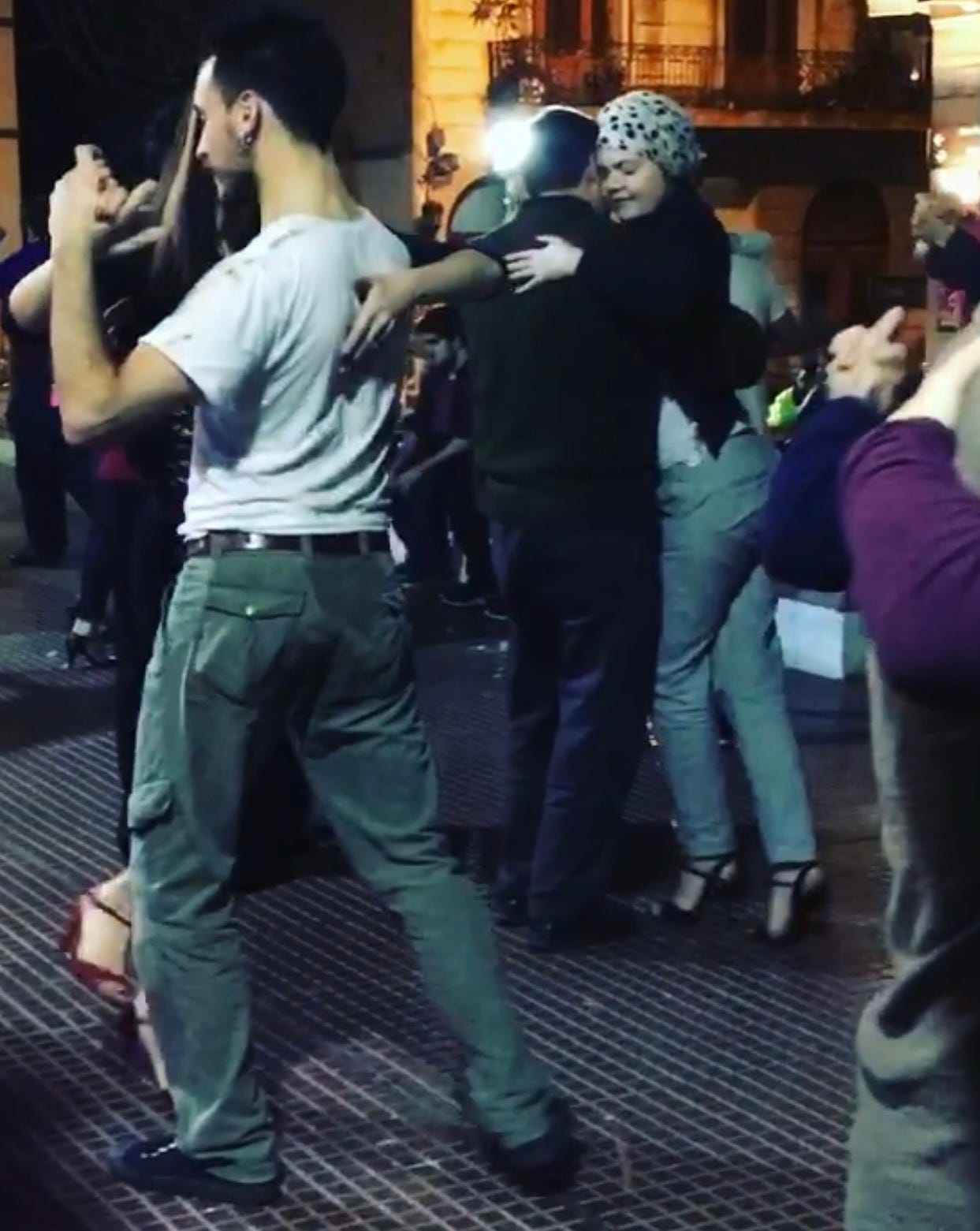
Like documentary makers know from direct experience, building these containers starts with a simple but profound shift: asking questions rather than providing answers. We can create spaces where people can sharpen their curiosity about other ways and other worlds, while sharing meaning together—exactly what stories do at their best.
I’m reminded of the Story Center bumper sticker I pinned above my desk: “The shortest distance between two people is a story.”
More than ever now I believe this simple insight. Do you?
:::::::::::::::::::::::
If you enjoy my writings on open space new media, consider recommending my Substack to a friend or leaving a comment!
This is brilliant and tender and incisive. Keep writing!
I simply love this. I would've been in that ballroom for novices in February except for an injury, and I, too, have moved away from film and career "goals" to focus instead on shared experiences. I'll check out those books. Thank you!